





Deploying to production shouldn’t feel like defusing a bomb. Yet for many teams, every release is a stressful experience. The good news is, it doesn’t have to be this way.
Production deployments can and should be routine, predictable, and boring. In this guide, we’ll break down how to eliminate deployment anxiety, ensure business continuity, and implement scalable deployment strategies.
What you’ll learn in this article:
- Why deployment fear exists (and how to conquer it)
- Strategies for automating and de-risking releases
- The essential DevOps and SRE best practices
- How to implement progressive rollouts, canary deployments, and rollback plans
- The tools that make every deploy a zero-downtime, stress-free event
Why Does Deployment Feel Risky?
Many engineers feel a sense of dread every time they push to production. Why?
1. Single Points of Failure (a.k.a. “Brent Syndrome”)
Every company has (or has had) that one person (let’s call him Brent) who knows everything about the infrastructure but refuses to share knowledge. When Brent deploys code, nobody else understands the process. If he quits or takes a vacation, the entire system is at risk.
Solution:
- Document everything! From deployment steps to rollback procedures.
- Implement a rotation policy where multiple engineers handle deployments.
- Use Infrastructure as Code (IaC) so deployments can be reproduced programmatically.
2. Poor Observability and Monitoring
If something breaks post-deploy, can you detect and fix it before customers notice? Many teams deploy blindly, assuming everything will be fine – until it isn’t.
Solution:
- Implement real-time monitoring and alerting with tools like Prometheus, Grafana, and Datadog.
- Use synthetic testing and canary analysis to catch issues early.
- Set up automated rollbacks if errors exceed a threshold.
3. Manual, Fragile Deployments
If your deployment process involves manually SSH’ing into servers and copying files, you’re living in the past, and it’s time to upgrade.
Solution:
- Use a CI/CD pipeline (GitHub Actions, GitLab CI, Jenkins, ArgoCD, etc.).
- Implement progressive rollouts (blue-green, canary, feature flags).
- Automate everything from testing to deployment approval workflows.
How to Deploy Without Fear
1. Automate, Automate, Automate
Your deployment pipeline should be fully automated, from pushing code to verifying production stability.
Must-haves for a production-grade CI/CD pipeline:
- Automated testing (unit, integration, performance, security)
- Infrastructure as Code (Terraform, Pulumi, CloudFormation)
- One-click rollbacks (feature flags, Kubernetes rollbacks)
- Staged deployments (canary, blue-green)
2. Use Progressive Delivery Techniques
Releasing code all at once is risky. Progressive delivery minimizes blast radius and allows for controlled rollouts.
Common progressive delivery strategies:
- Canary deployments: Release to a small percentage of users first, monitor for errors, then expand.
- Blue-Green deployments: Maintain two environments and switch traffic only when the new version is fully validated.
- Feature flags: Deploy code without enabling it until validated in production.
3. Establish a Culture of Postmortems
One of the biggest barriers to fearless deployments is fear of failure. Engineers are often afraid of being blamed if something goes wrong.
Change the culture by:
- Conducting blameless postmortems – focus on what happened, not who did it.
- Automating rollbacks – make reverting a change fast and painless.
- Sharing deployment knowledge – onboarding new team members on the deployment process.
4. Monitor Everything & Set Up Automatic Rollbacks
Deploying to production means expecting the unexpected. Your monitoring setup should detect failures in real-time and act accordingly.
Monitoring essentials:
- Real-time observability: Dashboards (Grafana, Datadog, Prometheus)
- Automated rollback triggers: If error rates spike, rollback automatically.
- Synthetic monitoring: Catch regressions before users experience them.
5. Ensure Business Continuity: Eliminate the “Hero Engineer”
A single engineer running deployments (or being the only one who knows how) is a disaster waiting to happen.
Fix it by:
- Cross-training engineers to avoid silos.
- Documenting SOPs for every deployment scenario.
- Using GitOps to manage infrastructure changes declaratively.
The Tech Stack for Stress-Free Deployments
If you want boring, repeatable, stress-free deployments, here’s the tech stack we recommend:
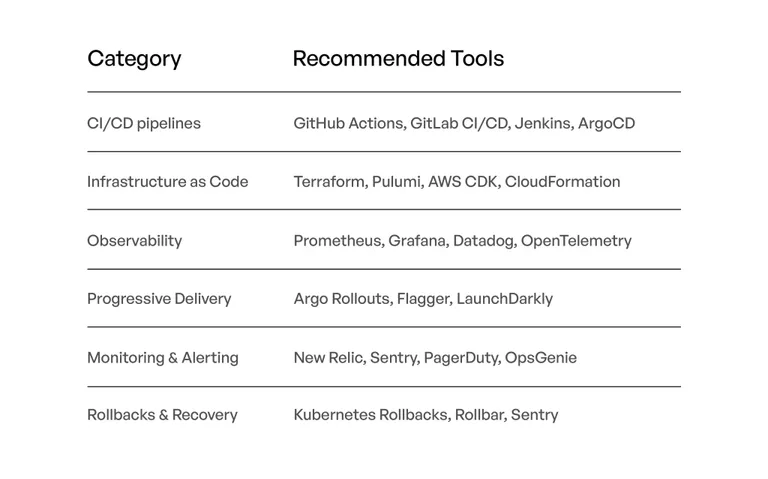
TL;DR: Deploy with Confidence
If your team dreads deploying to production, you have a process problem, not a people problem.
- Make production deployments repeatable and predictable.
- Automate every step from testing to monitoring.
- Use progressive delivery (canary, blue-green, feature flags).
- Document, cross-train, and eliminate single points of failure.
- Monitor everything and rollback fast when needed.
With the right processes and tooling, every deployment will turn from a source of stress to a routine. Now go forth and deploy fearlessly.
Ready to Make Every Deployment Boring and Fast?
If you’re committed to eliminating deployment anxiety and transforming your release process, our DevOps-as-a-Service offering is built to help.
We embed proven DevOps practices, automation, and culture directly into your teams to accelerate delivery and remove single points of failure.
Get in touch with our DevOps experts to streamline your delivery!