





Australian organizations have been using offshore software development for decades, but as software delivery becomes central to how businesses operate and scale, the model you choose determines whether offshore delivery becomes a long-term engineering asset or a revolving door of vendor arrangements. Deloitte’s 2025 Global Business Services Survey shows that global service delivery models are evolving as organizations place greater focus on Generative AI, digital capabilities, cost efficiency, and customer experience.
Offshore software development guide: a decision framework
| Your Situation | Model | Ownership Outcome | Natural Next Stage |
|---|---|---|---|
| Defined scope, one-off initiative | Project-based delivery | None. Context leaves with the team when the project ends. | When delivery becomes ongoing or the roadmap expands beyond the original scope. |
| Scaling capacity fast with strong internal leads | Staff augmentation | Limited. The team extends your internal capability, but the operating structure, employment setup, and continuity model remain with the partner. | When you need the team to outlast any one person or build cumulative product knowledge. |
| Offshore engineering as a long-term strategic asset | ODC via Build-Operate-Transfer | Full. Entity, staff, infrastructure, IP, and AI-aligned delivery practices and components built during the engagement transfer to you at maturity. | This is the destination. For more, see the CBTW BOT service page |
Five pitfalls: what every offshore software development guide should cover
These are the failure modes that appear consistently across organizations of all sizes, and the ones an offshore software development guide for Australian buyers should address directly rather than paper over.
Treating it as a cost play
Offshore software development reduces cost as a byproduct of accessing a larger, high-quality talent base. Organizations that optimize primarily for the lowest day rate tend to get exactly what they pay for: low-context, high-rotation teams with limited investment in delivery quality.
Underestimating onboarding
The offshore team’s time to contribution depends almost entirely on how well they are set up: documentation quality, tooling access, direct contact with internal leads, and a clear understanding of the product roadmap. Teams left to figure things out independently take much longer to become effective.

Leaving governance as an afterthought
IP protection, access controls, coding standards, security policies, and compliance requirements need to be defined before the engagement starts, not resolved after an incident. This applies equally to AI-assisted development: ownership and governance of AI-related patterns, models, and automation components should be established at the outset.
Managing the partner instead of the product
The most common management failure is treating the offshore team as a vendor to be monitored rather than an extension of the engineering organization. This creates the communication and quality problems that reinforce the stereotype. Organizations that embed offshore engineers into planning, review, and decision-making cycles get fundamentally different results.
Building on a structure you cannot own
In a standard vendor arrangement, the offshore team, the entity, and the institutional knowledge belong to the vendor. As AI becomes embedded in how software is built, the AI-aligned practices, patterns, and automation components developed during the engagement are also assets that belong to that structure. When the engagement ends or the relationship deteriorates, those leave too. Organizations building long-term offshore capability need a model that gives them a path to ownership, not a dependency they cannot exit cleanly.
Building Resilience: Continuity, Infrastructure, and Governance
A resilient offshore center keeps delivering when people leave, demand shifts, or an incident occurs. What separates delivery models is what stays in place underneath when headcount moves. That is designed in before work starts, around three foundations.
Continuity
In a Build-Operate-Transfer center, new hires join a legal entity, governance, and delivery infrastructure that do not need to be recreated each time someone leaves. When assessing continuity, check attrition, dedicated staffing, documented knowledge, and how replacements are onboarded.
Infrastructure
In a vendor-managed model, the legal entity, governance structure, and delivery infrastructure sit with the vendor by design. That gives you flexibility without carrying the overhead, but the structure stays with the vendor when the engagement ends. Under Build-Operate-Transfer, the entity, staff, infrastructure, and IP transfer to you, so they stay in place however headcount moves. Ask what has to move when the engagement ends, and who moves it.
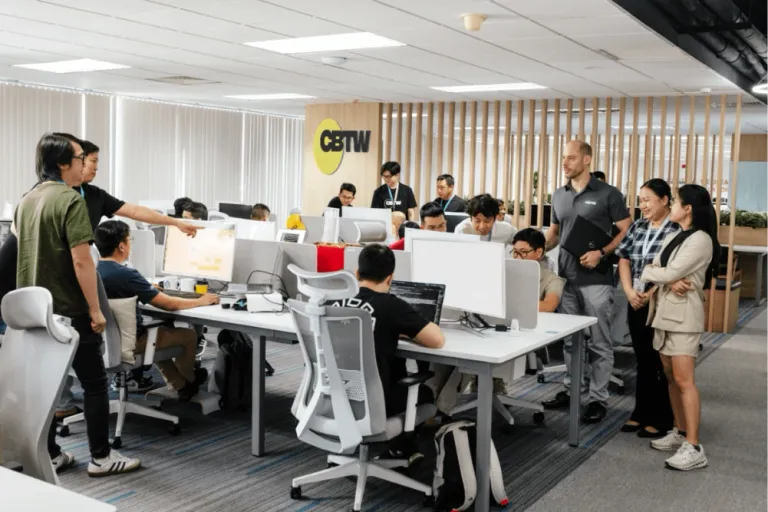
NAB shows what that makes possible. Through Build-Operate-Transfer, CBTW grew NAB’s Vietnam engineering team to more than 600 engineers by the time of transfer, after 3.5 years. Under NAB’s own ownership, its Vietnam centers now employ more than 2,000 people, growth built on a legal structure, governance, and infrastructure NAB already owned.
Governance
Governance defined before the engagement starts stays active through shared delivery metrics and regular risk reviews. In a Build-Operate-Transfer center, the governance structure transfers with the entity, so it stays in place after transfer rather than being re-established.
“If the goal is flexibility without long-term infrastructure responsibility, a vendor-managed model does that well. If the goal is building a capability the business will hold and grow for years, a Build-Operate-Transfer structure means the legal entity, governance, and delivery infrastructure stay in place no matter how headcount moves.”
Dirk Arend, BOT Leader Partner APAC, CBTW
Offshore Product Development: Owning the Product, Not the Tickets
Resilience keeps a team delivering. Offshore product development builds on it: a dedicated offshore team owns a product’s outcomes over time, not only a set of tasks.
That reflects the difference between a vendor and a partner. As CBTW’s Partner vs Vendor analysis puts it, a vendor relationship succeeds when agreed services are delivered efficiently, while a partnership succeeds when both organizations improve delivery capability together over time.
Offshore product development depends on stable people, direct access to internal leads, and clear ownership of what gets built.
CBTW’s work with Atlassian shows the pattern. Over three years, CBTW helped Atlassian build a dedicated engineering hub of more than 150 Java engineers, product managers, designers, and support specialists, working directly on core products including Jira and Confluence. Rather than operating as a separate delivery supplier, the team became an extension of Atlassian’s engineering organization, and the center was transferred to Atlassian when the time was right.
What to Ask Before Choosing an Offshore Software Development Partner
A few direct questions separate partners built for long-term delivery from those built for short-term revenue.
What happens to IP developed during delivery?
This includes application code, automated test suites, AI-related patterns, models, or automation components introduced during the engagement. Get the IP position in writing before work begins.
How is the team structured for continuity?
Ask about voluntary attrition rates, notice periods, and whether engineers are dedicated to your engagement or shared across clients. Continuity of people is continuity of product knowledge.
What does AI-assisted delivery look like in practice?
Offshore software development in 2026 should include AI-aligned delivery practices embedded across the lifecycle: from how code is generated and reviewed to how testing and sprint processes are structured. Ask how the partner embeds these practices, how AI-related outputs are governed, and who owns any AI-related patterns or automation components produced during the engagement. If those assets sit within the vendor’s own framework, they may not transfer cleanly when the engagement ends.
What is the path if you want to scale or exit?
A partner confident in their model will answer this clearly. If scaling requires renegotiation or exit requires leaving your team behind, the model is not structured in your interest.
Where Build-Operate-Transfer Fits in This Guide
The other models each solve part of the problem. Project-based delivery prioritizes execution over continuity. Staff augmentation prioritizes speed over structure. A dedicated team prioritizes delivery over ownership. BOT addresses all three, with a defined path to owning the capability outright.
Stable teams on long-running engagements also build AI-ready delivery foundations: the practices, patterns, and governance that make AI a reliable part of how engineering gets done. Under BOT, those foundations transfer with the entity. They are part of what you own.
For Australian organizations where offshore software development is becoming core to how engineering gets done, committing to the right model early is worth the attention. The right offshore software development guide helps you identify which model fits where you are now, and where it can take you.

Next steps
Where you go next depends on where you are. If you are evaluating offshore delivery for Australia, start with the CBTW Offshore Development Center Australia page. If you want to understand the model before committing to a structure, What is an Offshore Development Center covers the full maturity path from dedicated team to BOT. As your team grows, see how to scale remote engineering teams for long-term success.
Start Building Your Offshore Strategy
Choose the path that aligns with your current stage, whether you’re exploring offshore delivery in Australia or looking to understand the ODC model. Start with the right foundation and move toward a scalable, long-term capability.