Most engineering leaders searching for offshore delivery options start with the same term: offshore development center. It is the right instinct. But the organizations that scale fastest, protect their IP most effectively, and reduce vendor dependency over time tend to take the model further. Understanding what is an offshore development center is the starting point. Understanding why the best ones become Build-Operate-Transfer is where the real decision gets made.
What is an offshore development center
An offshore development center, or ODC, is a dedicated team of engineers located in another country that works exclusively for your organization. The team operates within your tools, follows your processes, and is accountable to your delivery standards, not a shared vendor pool.
That is why offshore development center remains the term many Australian leaders search for when they want to scale software delivery offshore. It signals dedicated capacity, closer integration, and stronger continuity than basic outsourcing.
But an ODC only describes the team structure. It does not automatically solve the bigger question: who ultimately controls the team, the governance model, the infrastructure, the intellectual property, and the AI-enabled delivery practices built during engagement?
That is where Build-Operate-Transfer takes the model further. BOT starts with the familiar ODC concept, then builds the offshore center with eventual transfer and ownership already designed into the operating model. For broader context on how offshore development centers are structured, see the TechBlocks guide to offshore development centers.
Why a traditional ODC is no longer enough
Traditional ODCs can help organizations access talent, reduce delivery bottlenecks, and expand capacity. But many ODC models still leave the client dependent on a provider for day-to-day operations, hiring, governance, office setup, delivery management, and knowledge continuity.
That dependency becomes a problem when software delivery is strategic, when AI becomes embedded in engineering workflows, and when the organization wants the offshore capability to become part of the business rather than remain an external service.
A conventional offshore development center gives you people. Build-Operate-Transfer gives you a structured path to control.

How ODC, BOT, and other delivery models differ
| Model | What it means |
|---|---|
| Outsourcing | A vendor’s shared team delivers a defined project or function. It can be useful for short-term execution, but it often reinforces vendor dependency. |
| Offshore development center (ODC) | A dedicated team works exclusively for your organization and is integrated into your delivery environment. |
| Build-Operate-Transfer (BOT) | The mature ODC model. A specialist partner builds and operates the offshore development center, embeds governance and AI-ready delivery practices, then transfers full ownership once the operation is ready. |
| Nearshoring | Offshoring to a nearby country with time zone proximity. Vietnam gives Australian and APAC organizations strong collaboration overlap. |
| Staff augmentation | Individual contractors are added to supplement an existing team, without the operating structure of an ODC or BOT model. |
| Freelancing | Independent individuals are engaged for specific tasks, with limited continuity, governance, or integration. |
Four things buyers get wrong about ODCs
The operating model is what separates an ODC from outsourcing
The structural difference is how the team is organized and for whom. Conventional outsourcing is arranged around a vendor’s delivery capacity. An ODC is arranged around one organization’s continuity, standards, and product context. Under Build-Operate-Transfer, your organization eventually owns the team entirely.
Sustained engineering demand matters more than company size
The relevant qualifier is sustained delivery demand, not headcount. Growth-stage SaaS companies, fintechs, and digital platforms use ODCs when delivery needs extend beyond what local hiring alone can support. BOT scales with that trajectory, building governance and infrastructure appropriate to each phase.
Governance determines what regulated industries can deliver offshore
Concerns about regulated industries operating offshore come down to governance choices: the right certification, delivery practices, and legal structure. Under the BOT model, the offshore development center operates as a Wholly Owned Foreign Entity, with the client controlling the legal structure and IP framework. National Australia Bank’s Vietnam engineering hub delivered regulated banking capability at scale before transferring to NAB’s ownership.
Time to contribution depends on delivery structure, not model label
Slow time-to-value usually reflects underprepared onboarding and withheld delivery context. The BOT model addresses this structurally: shared services, governance, and tooling are built into the operating model from the start.
When an offshore development center is right for you
An ODC fits when your engineering delivery has become continuous rather than project-based, when your internal leads can collaborate directly with a distributed team, and when the goal is a long-term capability your organization controls. The model is less suited to well-scoped, time-bound initiatives, where project-based delivery is a cleaner fit.
For organizations earlier in that journey, a dedicated team extension is the faster entry point. Your partner manages local operations; you manage delivery. It works well for scaling a roadmap or building confidence in distributed delivery before committing to a full ODC structure. BOT is designed to begin at that stage and progress toward full ownership at your organization’s pace.
Foundations of a successful offshore development center
Clear product and technology direction
Your ODC works best when it is connected to a defined roadmap rather than a loose capacity request. In a BOT model, product priorities, architecture direction, and delivery goals should be clear enough for the team to mature toward eventual ownership.
Internal leads ready to collaborate directly
Your product owners, architects, delivery leads, and engineering managers should be available to work with the offshore center through regular sprint cycles, technical discussions, and delivery reviews. BOT works best when your internal leaders stay close to the team throughout the build and operate phases.
Shared delivery cadence
Your ODC should be embedded into existing planning, backlog refinement, sprint reviews, release governance, and reporting routines, not operating as a separate delivery lane. This creates stronger continuity when the Build-Operate-Transfer model reaches the transfer stage.
Access to tools, environments, and documentation
Engineers need timely access to source code, collaboration tools, environments, technical documentation, product context, and onboarding materials to become productive quickly. For BOT, this also helps the team work inside your standards before ownership transfer.
Consistent standards across locations
Security, compliance, coding standards, AI usage, testing practices, and delivery governance should be applied consistently so the ODC works as part of the same engineering organization. This is especially important when the BOT path is intended to move the center into your ownership over time.
From dedicated team to ODC to BOT: the maturity path
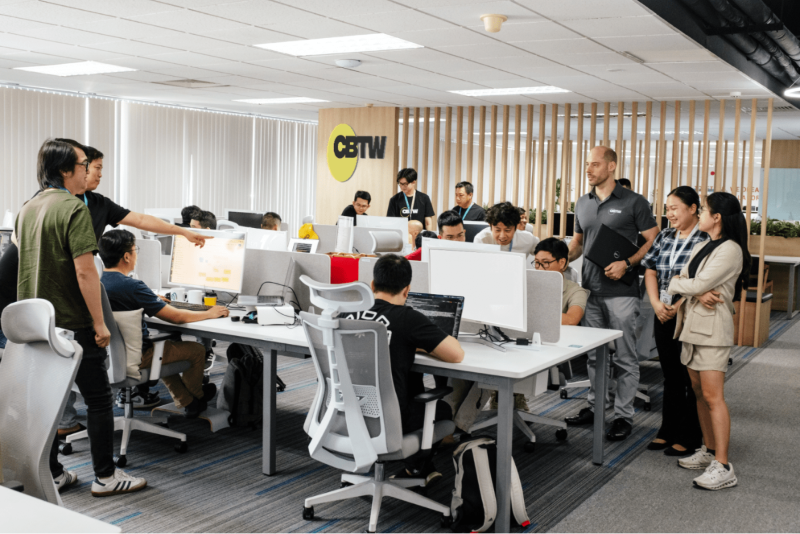
When practitioners fix offshore delivery problems by bringing the team structurally in-house, they are describing what Build-Operate-Transfer delivers by design. The clearest practical answer to what is an offshore development center at its most complete is a capability your organization owns, not a service it accesses. Three stages, each a meaningful shift in how much of the operating structure sits with you.
Stage 1: Dedicated team extension
Your partner manages the local entity: recruitment, HR, payroll, compliance, infrastructure. You manage delivery: priorities, standards, cadence, product direction. The entity, contracts, IP, and governance remain with the partner.
Stage 2: Full offshore development center
Your organization shapes the team directly. Standards, culture, delivery practices, and product context are embedded in how the center operates. The structural layer moves to you.
Stage 3: Build-Operate-Transfer
The specialist partner builds the entity, recruits the team, and runs shared services. Your involvement increases through the operate phase. At maturity, the full entity transfers: staff, infrastructure, contracts, and all IP developed during delivery.
NAB: what the endpoint looks like
National Australia Bank’s offshore development center in Vietnam is a direct answer to what is an offshore development center at full maturity. Established through BOT, it scaled to more than 650 engineers before transferring to NAB’s ownership. The hub now operates independently with more than 2,000 technology specialists.
For the full BOT model structure, see the CBTW Build-Operate-Transfer service page.