





A European organization operating at the core of the energy and utilities ecosystem supports transmission system operators across multiple countries. Its role sits at the intersection of coordination, reliability, and regulatory pressure. As the organization grew rapidly, project delivery started to show signs of strain. Deadlines slipped. Ownership became blurred. Project management practices varied from one team to another.
Leadership did not question the commitment of their teams. They questioned the structure around them. To move forward, the organization asked CBTW Strategy, Product & Transformation to perform a Project Governance Assessment and lay the groundwork for a clearer PMO organization.
Challenges
Our client’s challenges were not isolated incidents. They were structural.
Projects were managed by capable professionals, but without shared rules. The PMO existed, yet its role differed depending on the program. Reporting formats varied. Decision paths were unclear. Escalations depended more on personal networks than on defined governance.
Three issues stood out during early discussions:
- There is no clear project prioritization: decisions are mainly driven by perceived urgency and budget constraints, without a structured governance framework. There are no clear guiding principles.
- PMO and project managers operate in silos instead of working in close collaboration, within a climate of mistrust rather than mutual confidence.
- Governance discussions were often emotional, with limited factual grounding.
In their politically sensitive environment, subjective viewpoints strongly influenced decisions. What was missing was a common reference point. The organization needed facts, not interpretations.
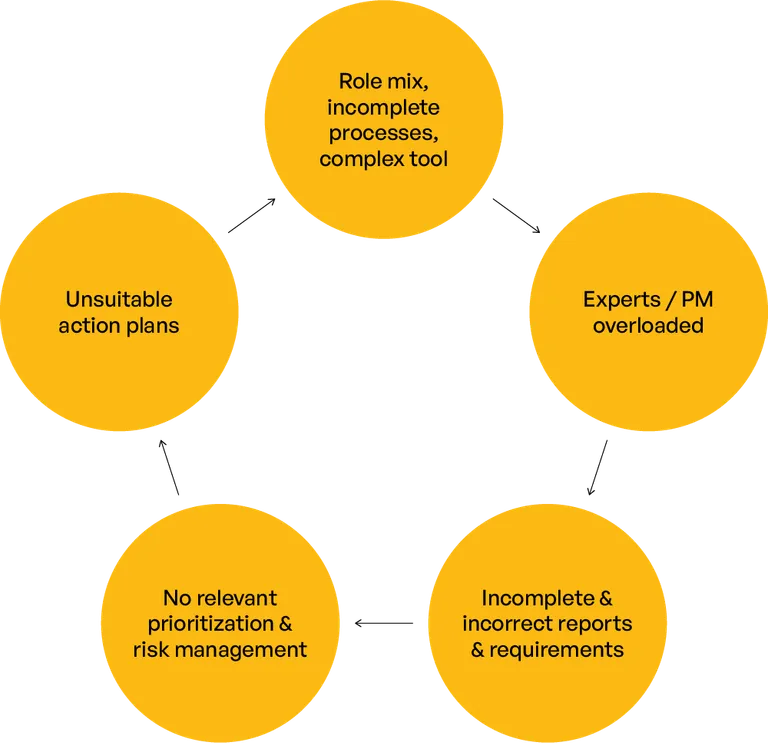
In conclusion, based on the points outlined above, the client was trapped in a vicious circle:
Our Approach
We approached the mission as a short, focused assessment, audit and analysis designed to create shared understanding fast.
The work followed a four-step structure over six weeks.
Step 1 – Kick-off and scoping
It started with a kick-off and scoping phase. This step aligned expectations, clarified objectives, and reduced early misunderstandings. In an environment where governance topics can quickly become political, this alignment proved essential.
Step 2 – As-is assessment
The second phase focused on collecting the “as-is” reality. CBTW conducted more than twenty one-to-one interviews across roles and seniority levels. Existing documentation, tools, and project practices were reviewed. Instead of summarizing feedback in abstract terms, inputs were translated into TOGAF-based scoring. Each response contributed to a structured view of governance maturity.
This allowed the team to map current practices against a standard project life cycle. Weak points became visible without pointing fingers. Strong practices were identified as anchors for the future.
Step 3 – Governance mapping and gap analysis
From there, CBTW moved to consolidation and gap analysis. The Project Governance Assessment produced clear visual outputs: assessment maps, scoring radars, and service blueprints. These visual and easy to understand assets helped teams discuss governance without reverting to personal positions but based on facts and figures.
Step 4 – To-be scenarios and roadmap
The final phase focused on direction. Rather than a single target model, CBTW designed several “to-be” scenarios.
Each scenario was built around 7 concrete variables such as risk exposure, duration, and skill requirements.
This gave leadership options, not prescriptions. A pragmatic roadmap and action plan closed the loop.
Throughout the mission, the TOGAF framework served as a neutral backbone. It helped structure discussions, frame maturity levels, and maintain consistency across teams.
Benefits
The organization gained a shared view of its project governance reality. Teams could see where practices diverged and why. Governance discussions became calmer and more focused, grounded in observable data rather than assumptions.
The clarified PMO organization made responsibilities explicit. Project managers and PMO roles were no longer competing or overlapping. Leadership gained a clear sequence of actions to improve delivery without disrupting ongoing operations.
Most importantly, the organization left the mission with the ability to move. The roadmap was not theoretical. It prioritized what could start immediately and what required preparation. This shift from analysis to action restored confidence across stakeholders.
How CBTW Supports PMO and Governance Challenges
Our Strategy, Product & Transformation service line helps organizations bring structure where complexity has accumulated over time. To ensure a comprehensive, both vertical and horizontal view of needs, our experts work with all relevant stakeholders — from top management to operational roles considering the full project live cycle — to assess governance models, PMO maturity, and project execution practices.
Our approach to PMO Audit and Project Governance Assessment combines field interviews, structured frameworks, and concrete visual outputs that make discussions easier across roles and departments. We focus on clarity, ownership, and scalability rather than templates or generic models. This approach is built on deliberately cross-functional principles. It can be applied to any organization, regardless of sector, as well as to a specific department, process, or operating model, whenever coordination, governance, and decision-making are at stake.
If you witness symptoms persisting, or if your teams find themselves caught in a recurring cycle of urgency, misalignment, and unclear ownership—a PMO Audit becomes a necessary step to restore control, reframe priorities, and create a sustainable path forward.
Our experts can help you step back, assess your current setup, and define realistic next steps at your pace and within your constraints. Find more about our solutions here.
Feel free to reach out to discuss how this type of assessment could support your organization.