





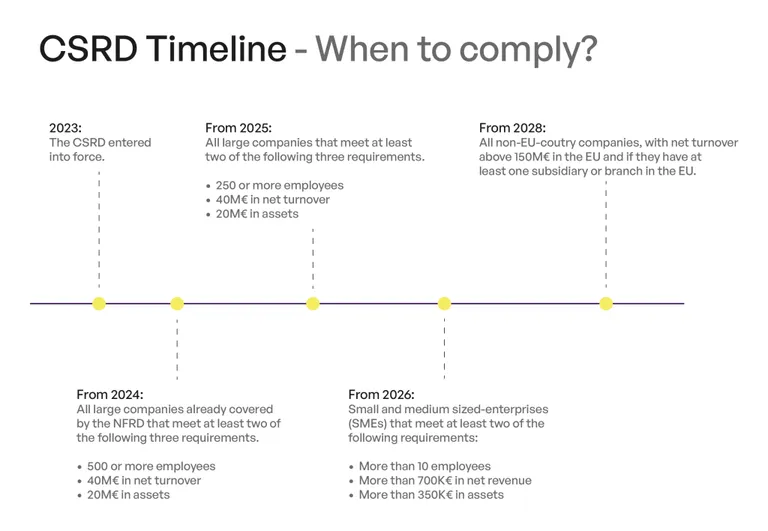
Starting in 2025, the Corporate Sustainability Reporting Directive (CSRD) will challenge EU companies on sustainability reporting. In its final stage, over 50K companies in the EU, including 15K companies from Germany, will have to report holistically on their sustainability performance, adhering to ESG reporting standards1. This imposes a massive effort for these companies concerning data and sustainability management. However, the underlying goal of the CSRD poses an even greater challenge: mastering the transformation towards a net-zero and circular economy driven by robust data analytics and insights.
At CBTW, we are convinced that thinking Sustainability and Data Products together, by taking a data-driven sustainability approach right from the beginning, is crucial to deal with this transformation. The upcoming transparency requirements and other ESG reporting challenges posed by CSRD are clear indicators that we are on the right track.
But HOW to bring all this to life in an organization to drive meaningful change?
Well, the best way to approach the transformation into a sustainable, digital future is to incorporate some key principles along with an integral data-driven focus.
Focus on Actions That Have a True and Measurable Impact
Identifying genuine change is daunting, particularly when many solutions look like greenwashing. But it does not have to be like that. We don’t have to settle for small fixes that don’t make the difference.
To embark on a successful sustainability transformation powered by data, it is imperative for businesses to adopt an impact-driven mindset.
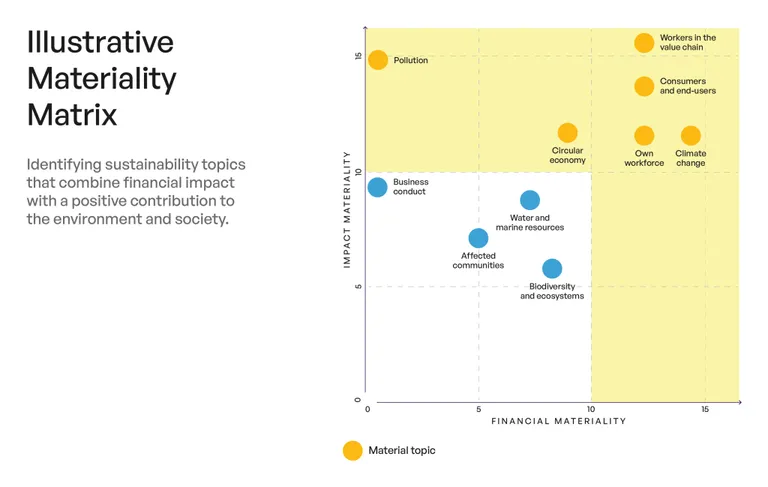
CSRD requires us to identify what information is relevant or “material” to our stakeholders. This can be achieved through a materiality assessment: bringing together both the impact and financial dimensions. A conscious and in-depth analysis of both the impacts on the environment and society as well as the risks and opportunities to our own business activities is a key first step. But this is also a unique opportunity to go beyond compliance and create a roadmap that focuses on the pursuit of genuine, measurable impact.
But how to achieve impactful results?
As a matter of fact: ‘you cannot manage what you don’t measure’. This is obviously the first step, but we want to go further. Therefore, a data-driven approach throughout the entire process will be key to identifying those actions that have a real impact.
Integrating sustainability metrics into traditional controlling processes will allow you to assess actions from cost, complexity, and impact perspectives all at once. To achieve this, strong capabilities in data collection from various sources, data analysis, and insight generation are needed. Additionally, reporting skills are essential to communicate these findings to both internal and external stakeholders.
Place Humans at the Center of All Your Activities to Drive Real Change
A human-centered approach is a goal in itself for more and more companies that understood that their endeavors cannot disregard the well-being of all people involved. Furthermore, by taking this path, cost optimization and profit will follow by:
- attracting and retaining talent;
- resonating with a wider audience that reclaims more human action from the companies they buy from;
- reducing costs by optimizing the way tedious tasks are executed;
- and so on…
Moreover, engaging all stakeholders and employees in the transformation process is crucial to co-create sustainable solutions and foster proactive change agents. Encouraging innovation, collaboration, and knowledge-sharing empowers individuals to contribute to sustainability goals and aligns their individual purpose with the organization’s vision. As a starting point, this means that not only the Sustainability Office members need to sit at the table to discuss an appropriate data strategy for sustainability. On the contrary, stakeholders of every business unit should be involved.
Later on, to effectively support employees with the implementation of the developed strategies, an active moderation of the ongoing change process is required. This calls for an agile and comprehensive approach with regular feedback loops to build the change together.
Setting up a clear communication strategy combined with precisely defined metrics to measure the change and adoption during the process is critical. This facilitates the inclusion of all relevant actors in the company, fostering a sense of ownership and responsibility.
Choose a Holistic Approach Recognizing That a System Is More Than the Sum of Its Parts
Understanding that sustainability transcends environmental issues to include often-ignored social dimensions is vital. These include:
- the well-being of communities,
- fair labor practices,
- and broader societal contributions.
Besides, the complexities of cross-impacts within a company highlight the need for an all-encompassing strategy. Integrating sustainability practices into every layer of business operations, from supply chains to employee engagement initiatives, fosters a broad transformation that extends beyond mere data collection. Utilizing data to gain 360-degree perspectives drives comprehensive transformation rooted in ESG reporting standards.
Through holistic and participative change support, organizational development is driven forward based on the strategies and measures that emerge from CSRD reports.
Keep Implementation Processes in Mind While Setting Up Your Sustainability Strategy
We believe that sustainability and digitalization must be at the core of a company’s strategy. But introducing them might be a prolonged process. Nevertheless, it should not be left only at the strategic level but quickly move forward to the implementation, generating fast and tangible results that can be measured and improved in following iterations.
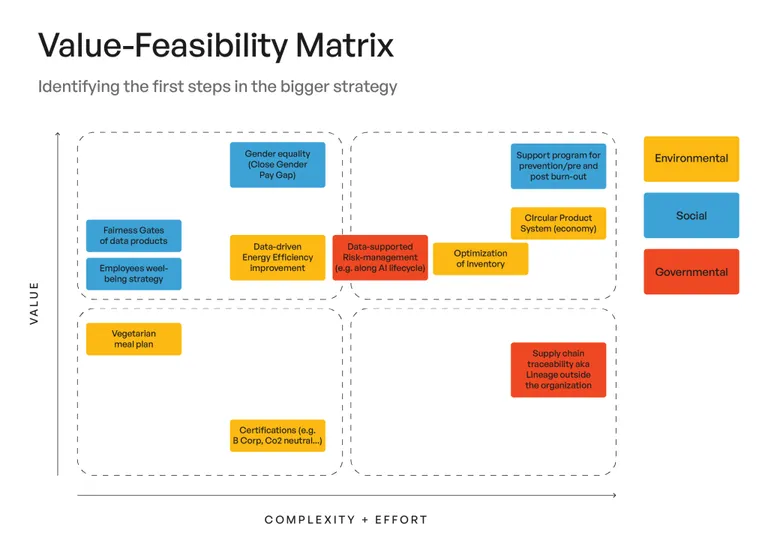
A harmonious integration of strategy and implementation is key here. Ideally, companies aim for developing an actionable strategy that allows them to start with the first use cases while still finalizing their strategy. A solutions/use cases-oriented approach can help you identify those low hanging fruit that have high impact but lower complexity (and lower costs).
Reduce Complexity to Kick Off Your Data-driven Sustainability Journey
Sustainability and data are both extraordinarily complex topics that can be addressed from multiple perspectives. Navigating the transformation process can be overwhelming, especially for small and medium companies.
Narrowing the focus to solution-oriented approaches for major challenges is crucial to make them manageable.
Expertise from the sustainability field and the data side should converge in a way that enables us to explain both worlds in everyday language. Sharing know-how and ideas throughout the company should happen on a level so that everyone from the worker in production or the customer service agent up to the top management can understand.
Measuring impacts is clearly the first step towards developing more sophisticated ways of reducing it. It is easy to fall into the trap of trying to solve everything at the same time. But identifying the biggest impacts from the beginning and addressing those first assures the right focus.
Tailored data solutions can be instrumental in this segmentation, offering bite-sized insights and strategies for companies to gradually embrace and integrate.
How to Start Putting All the Pieces Together?
Embracing sustainability is more than just paying lip service to a trend. It’s about:
- Taking calculated, data-driven decisions and actions that create genuine, measurable change.
- Centering efforts on actions with a genuine and quantifiable impact, instead of merely ticking boxes.
- Placing humans at the heart of every initiative to ensure that the transformation not only benefits the environment but also resonates deeply with the very people driving the change.
- Adopting a holistic approach, acknowledging the interdependent facets of business operations.
- Moving quickly, keeping in mind that devising a strategy is crucial, but tangible implementation is equally significant. This involves identifying high-impact, low-complexity tasks to address right off the bat.
- Reducing the complexity of these topics by breaking them down into manageable, actionable steps is the key.
As data and digitalization experts, both technically and strategically, we can support you on this journey. We have partnered up with sustainability specialists who focus on sustainable strategy, impact generation, and change management. Together, we co-create tailor-made plans rooted in data-driven insights.
Providing guidance on selecting the right digital tools, establishing robust monitoring systems, and ensuring continuous improvement through data-informed decision-making is our way. We’re here to guide, support, and empower companies in their journey towards a fairer, greener, data-driven future.
1Source: European Green Deal (europa.eu)