





For Australian businesses running or planning to run an offshore engineering hub in Vietnam, getting the legal entity right is only the first piece. Recruitment, facilities, tooling, and governance all need to stand up in parallel, and doing that well from day one separates a smooth build from a hub still being patched together six months in.
More Australian businesses are moving toward owning their offshore engineering hub outright, and the ones that find it easiest are almost always working with an offshore development services partner who runs the whole build, not just the legal paperwork.
The legal entity behind an owned offshore engineering hub
Full ownership starts with a Wholly Foreign-Owned Enterprise, usually written WFOE or WOFE, the structure that lets an Australian business own its offshore engineering hub outright in Vietnam, with no local partner and no shared control. It’s more than a two-step process:
| Step | What it establishes | Governed by |
|---|---|---|
| Investment Registration Certificate (IRC) | Approval of the investment project itself | Vietnam’s Law on Investment |
| Enterprise Registration Certificate (ERC) | The legal entity itself | Issued once the IRC is granted |
| Capital account registration | The channel for bringing investment funds into Vietnam | State Bank of Vietnam regulations |
| Tax registration | The entity’s tax identity and obligations | Vietnam’s General Department of Taxation |
| Labour and payroll registration | The entity’s legal right to employ engineers | Vietnamese labour law |
Vietnam’s Foreign Investment Agency eRegulations portal, maintained under the Ministry of Planning and Investment, sets out the procedural detail province by province. None of these steps are unique to an offshore engineering hub, they apply to any foreign-invested entity in Vietnam. The entity is the foundation. It isn’t the hub itself.
What actually has to stand up around the entity
Once the entity and compliance framework exist, an offshore engineering hub still needs people and a place to work. In practice that means running several workstreams in parallel:
- Recruitment, sourcing and hiring the initial engineering team against the client’s technical requirements, not a generic candidate pool.
- Facilities, securing office space, network infrastructure, and physical security appropriate to the client’s own standards.
- Tooling and access, provisioning repositories, environments, and security controls under the client’s governance from the first day of delivery.
Sequencing these badly, alongside the compliance obligations above, is the most common reason an offshore engineering hub takes longer to become productive than planned. None of that is a reason to be daunted. It’s the reason an experienced partner exists, to run all of it in parallel so the client never has to hold the whole sequence in their own head.
How an experienced partner makes this efficient
The efficiency comes from not treating recruitment, facilities, tooling, and compliance as four separate projects starting from a blank page. A partner who has run this sequence repeatedly already has recruiting pipelines, facilities contacts, and compliance templates in place, and already knows how privacy and prudential obligations shape infrastructure decisions before any hiring starts.
CBTW has been running this exact sequence over 25 times across Vietnam, for clients including NAB, Atlassian, MessageMedia, Ansarada, Magnolia, hipages, and more. With Ansarada, building the hub entirely within its own environments and governance from day one was a decision made once, at the outset, which is why the eventual transfer of ownership required no IP migration at all.
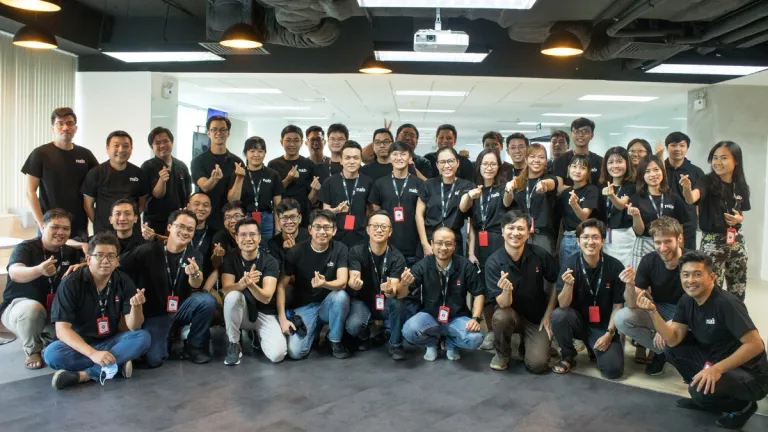
With NAB, the recruitment pipeline and infrastructure were built to scale from the beginning, so the hub’s later growth, from a small initial team to more than 650 engineers, and past 2,000 specialists under NAB’s own governance since, added onto an existing foundation rather than requiring any of it to be rebuilt.
“Clients don’t want to manage four different workstreams and hope they line up,” said Dirk Arend, BOT Leader Partner APAC at CBTW. “We run recruitment, facilities, tooling, and compliance groundwork together from day one, so the client experiences one hub coming online, not five separate problems they have to coordinate themselves.”
The practical takeaway
For an Australian business leader considering an offshore engineering hub in Vietnam, the entity is necessary but not sufficient. Recruitment, facilities, tooling, and compliance all need to run in parallel from the outset, and the efficiency of doing that well is exactly what an experienced partner is built to deliver.